%20(1).png)


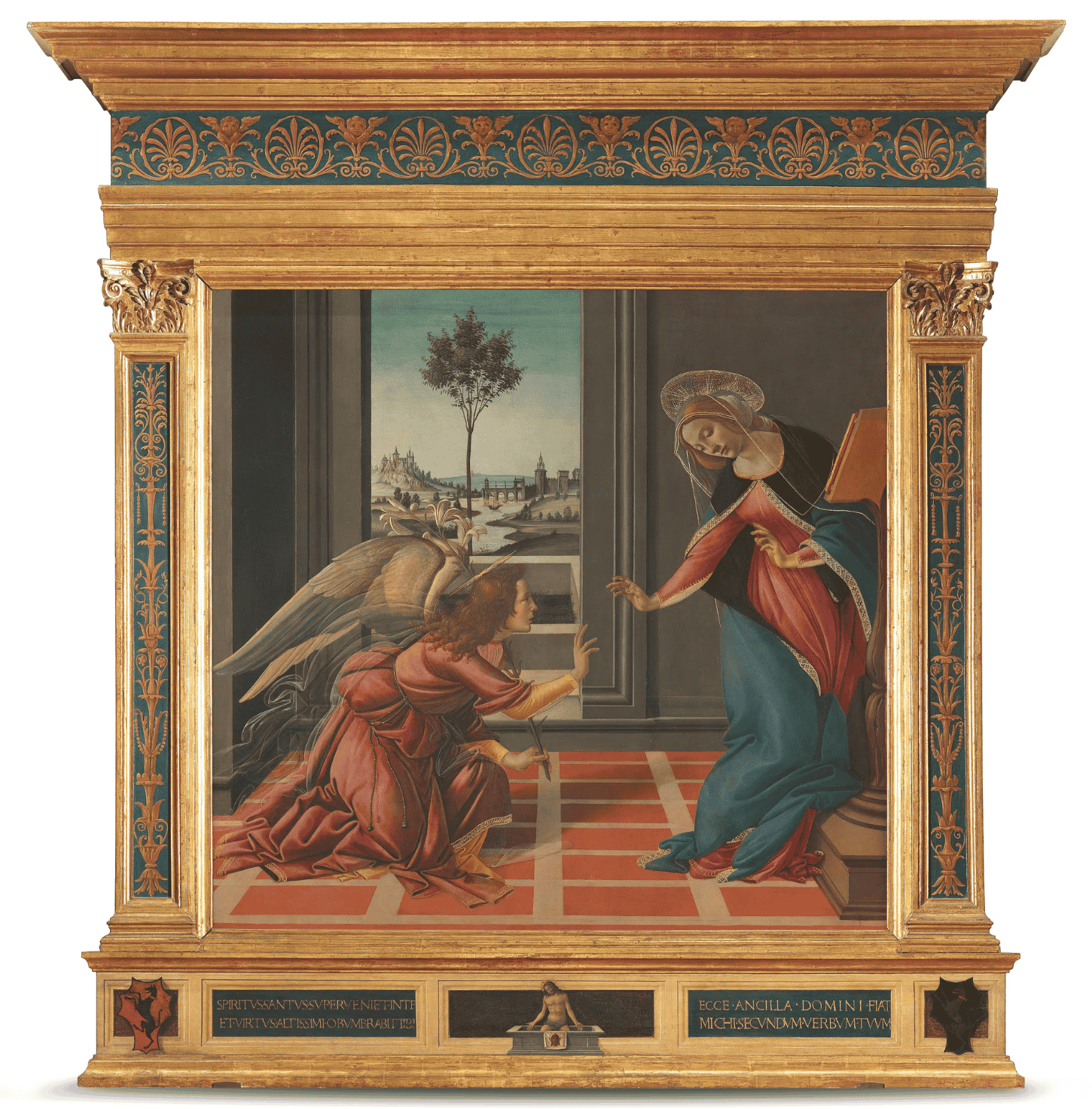
The Cestello Annunciation depicts the transformative impact of Christ’s incarnation. In his innovative treatment of one of the most popular motifs in 15th-century Italian art, Sandro Botticelli (1445-1510) visualizes the Virgin Mary, visited by Gabriel, being remade from a humble and pious girl into the mother of Christ.
This work, now in Florence’s Uffizi Gallery, is known as the Cestello Annunciation because it was painted around 1489 or 1490 for the convent of Cestello. For that liturgical context, Botticelli designed this altarpiece to make the blessings of God accessible to his presumed Christian worshiper. Even in the modern museum, the discerning viewer can appreciate this work’s sacred purpose. As Botticelli’s composition guides us through the biblical narrative, his altarpiece proclaims the significance of Christ’s incarnation as an agent of spiritual metamorphosis and unification.
One of the most conceptually original and visually captivating dimensions of this image is the Virgin’s dramatic pose. Her graceful movement not only activates Botticelli’s image, but also reminds us that, in this very moment, she is being spiritually filled with the Holy Spirit.
As we read Botticelli’s composition, the miracle unfolds from left to right. At the left, Gabriel has suddenly arrived from heaven. The kneeling angel has a message for the startled maiden. Gabriel’s gesture of blessing visualizes his pronouncement, “Greetings, you who are highly favored! The Lord is with you” (Luke 1:28).
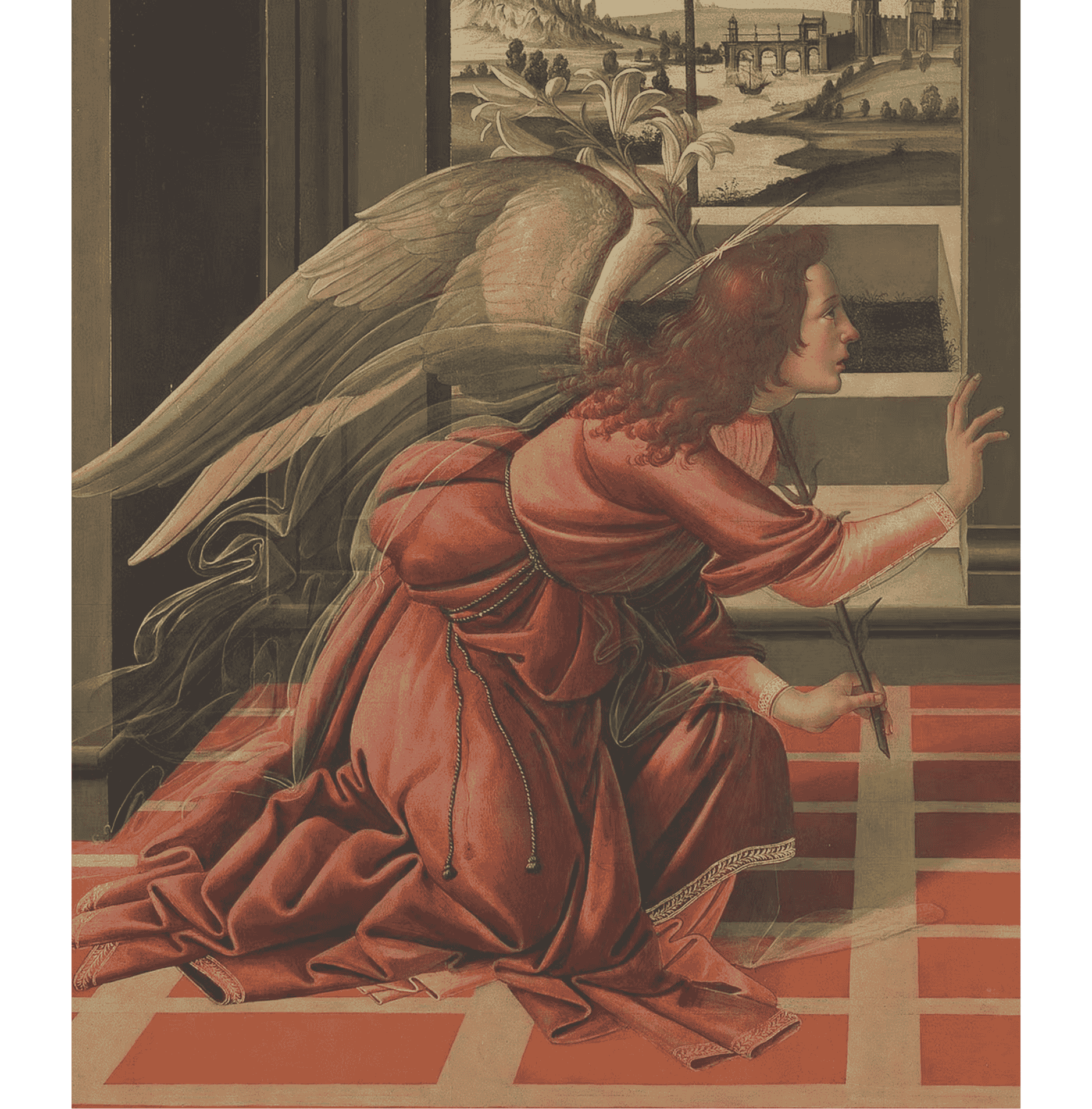
The complexity of Mary’s response to this annunciation is evidenced by her pose and gesture. Her outstretched hands express both hesitance and obedience. At first, she questions her heavenly visitor, “How will this be, since I am a virgin?” (Luke 1:34). But then, responding to Gabriel’s message that she will be the mother of God, Mary says, “May your word to me be fulfilled” (Luke 1:38). The swooning Virgin is simultaneously vulnerable and gracious. Responding to the angel’s pronouncement with both awe and angst, she accepts God’s plan.

The Cestello Annunciation also visualizes the incarnation of God through Botticelli’s treatment of the space in which this biblical drama unfolds. Gabriel finds Mary, engaged in her devotional reading, in a simple interior space. However, this room is more than just a stage on which the figures perform. Botticelli’s depicted architecture participates in both the structure of the composition and the organization of the sacred narrative.
We can see Botticelli’s creative method in the doorway behind the figures, as well as the red and white tiled floor on which they stand. Gabriel and Mary each occupy their own spaces within the three-dimensional room, but they are united by the two-dimensional design of Botticelli’s composition.
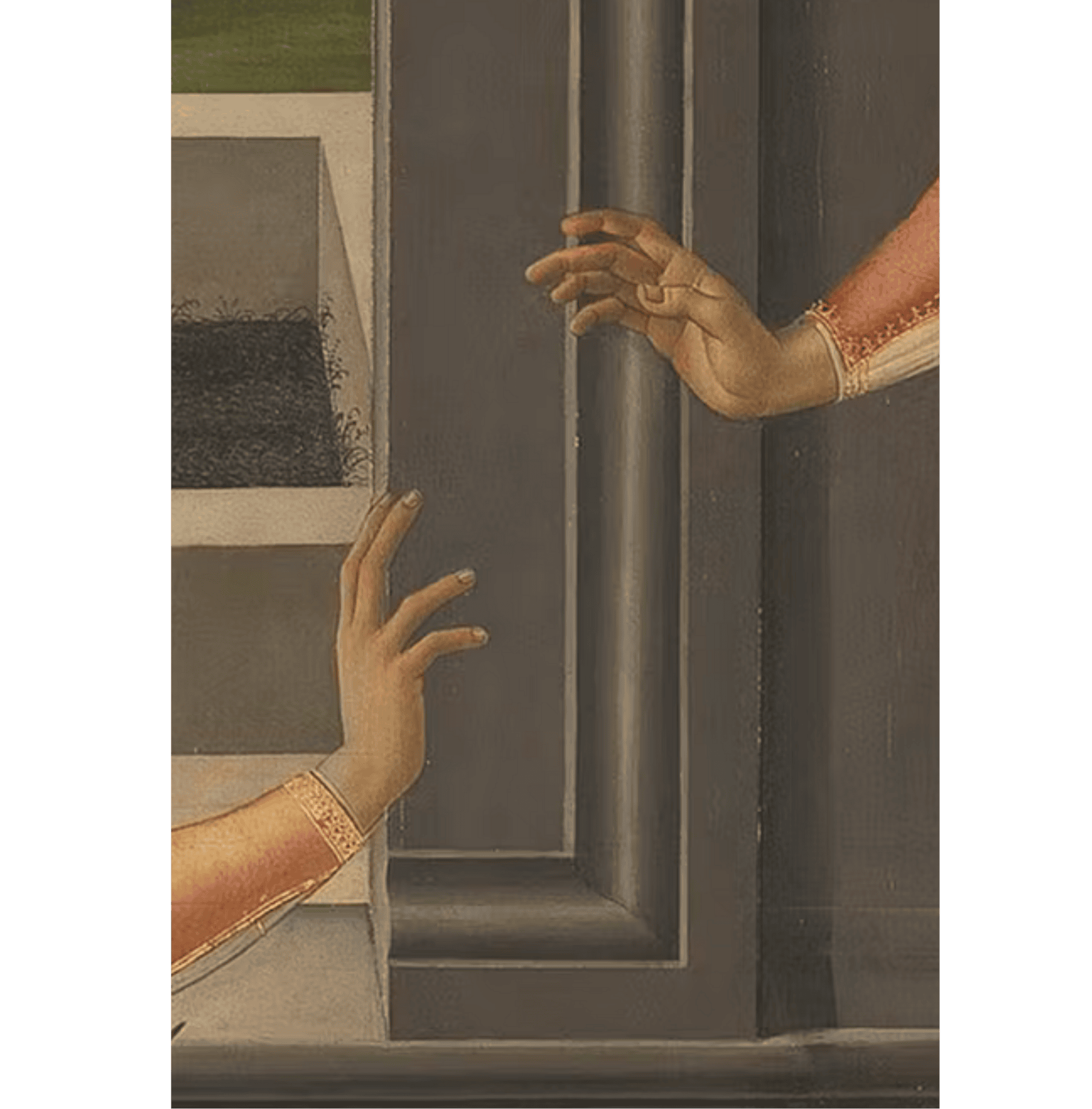
Gabriel is framed by an open doorway, through which we see an expansive landscape. While the distance seen through this doorway might suggest that the angel has come from afar, Gabriel has, presumably, entered the room through the door behind him. However, this architecture performs an important function in fulfilling this altarpiece’s sacred purpose of instructing the presumed Christian viewer. As the doorframe divides both the room and the painting, it visualizes a spiritual separation between Gabriel and Mary.
However, in the moment that we see, Gabriel and Mary meet at this doorframe with reciprocating gestures. As Gabriel’s hand is raised in benediction and Mary reaches out to receive his offering, their open hands are united within the doorframe. The spiritually charged space between Gabriel and Mary’s hands describes the Incarnation as an act of the invisible God entering into the world.
Furthermore, looking at the floor, we can observe how Gabriel and Mary occupy their own distinct spaces. Botticelli used the grid pattern of the red floor tiles, like the doorframe, to imply both spatial and spiritual boundaries. At the same time, Gabriel and Mary’s gestures and garments cross these borders.
In using this grid to define the space that Gabriel and Mary occupy, Botticelli demonstrates his knowledge of perspective. One of the most important creative inventions of the first half of the 15th century, artists of Botticelli’s generation, from Antonio del Pollaiuolo (1429/1433 –1498) to Pietro Perugino (1446-1523), explored how perspective could not only be used as a means of creating the illusion of three-dimensional space on a two-dimensional surface, but also as a narrative device.
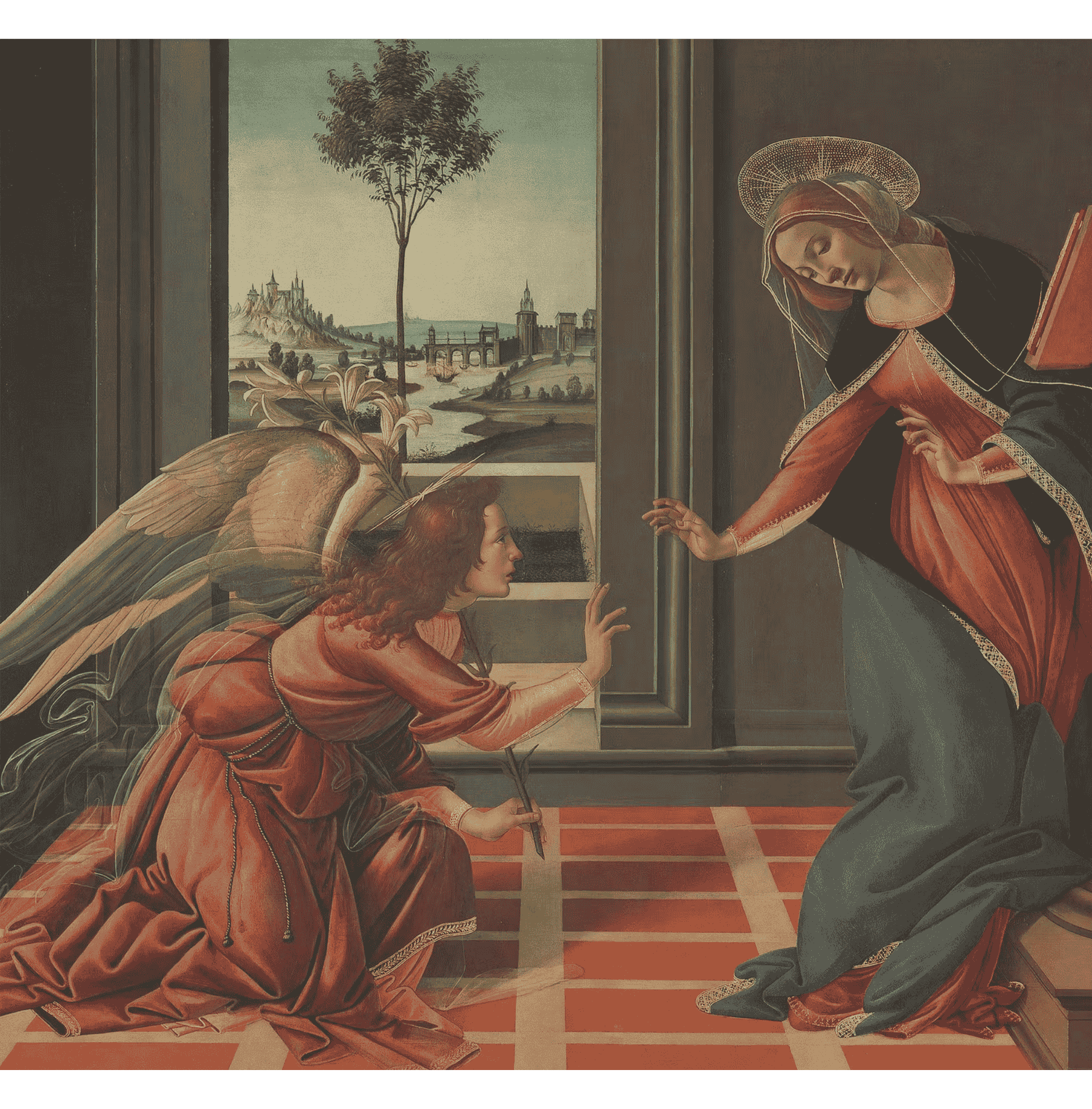
However, if the grid pattern of the floor demarcates the space, as well as the spiritual distance, between Gabriel and Mary, notice how the shadow of the kneeling angel subtly crosses into the very row of tiles on which Mary stands. This cast shadow, something that would have been beyond the capability of a Florentine painter a century earlier, not only advances the art of illusion in Renaissance art, but also reminds us of Gabriel’s words, “The Holy Spirit will come on you, and the power of the Most High will overshadow you. So the holy one to be born will be called the Son of God” (Luke 1:35). As this shadow bridges the space between Gabriel and Mary, God enters His own temporal creation.
In depicting the mystery of the Incarnation, Botticelli employed both pictorial space and composition to visualize the divide between God and humanity and, then, to show how this separation has been bridged. We see this in his creative treatment of the figures’ graceful movement across the room. This sacred drama culminates in Mary’s fluid pose. We are witnessing her becoming the vessel through whom Christ will be born.
********
Sandro Botticelli: Annunciation, 1489-90, Tempera on wood, 150 x 156 cm.
Sandro Botticelli (1445-1510) was an Italian painter and draughtsman. During his lifetime he was one of the most acclaimed painters in Italy, being summoned to take part in the decoration of the Sistine Chapel in Rome and earning the patronage of the leading families of Florence, including the Medici.
Dr. James Romaine is a Professor of Art History at Lander University. He is a graduate of Wheaton College and The Graduate School of the City University of New York. His books include Art as Sacred Perception and Beholding: Christ and Christianity in African American Art. Dr. Romaine’s videos can be found on his YouTube channel Seeing Art History.
********
Art For Advent 2025: Sandro Botticelli at the Uffizi Gallery
Sandro Botticelli is one of the most celebrated artists of the Italian Renaissance. Florence’s Uffizi Gallery holds some of his most famous works, including both The Birth of Venus and Primavera. And this collection also includes several outstanding paintings depicting biblical and devotional motifs. Please watch these videos by James Romaine on Seeing Art History.
First Sunday of Advent—The Madonna of the Magnificat, https://youtu.be/Ykexi3B-1_8
Second Sunday of Advent—The Madonna of the Pomegranate, https://youtu.be/_0sMceprGP4
Third Sunday of Advent—The Cestello Annunciation, to be posted
Fourth Sunday of Advent—The Adoration of the Magi, to be posted